Agriculture remains one of the most important sectors for trade, employment, food production, and economic development across Africa. Nigeria and Chad are two neighbouring African countries with significant agricultural activities and opportunities for cross-border commodity trade. The export and import of cash crops in Nigeria and Chad can create valuable opportunities for farmers, agricultural suppliers, …

Agriculture remains one of the most important sectors for trade, employment, food production, and economic development across Africa. Nigeria and Chad are two neighbouring African countries with significant agricultural activities and opportunities for cross-border commodity trade.
The export and import of cash crops in Nigeria and Chad can create valuable opportunities for farmers, agricultural suppliers, commodity traders, processors, wholesalers, exporters, importers, and businesses looking for reliable sources of agricultural products.
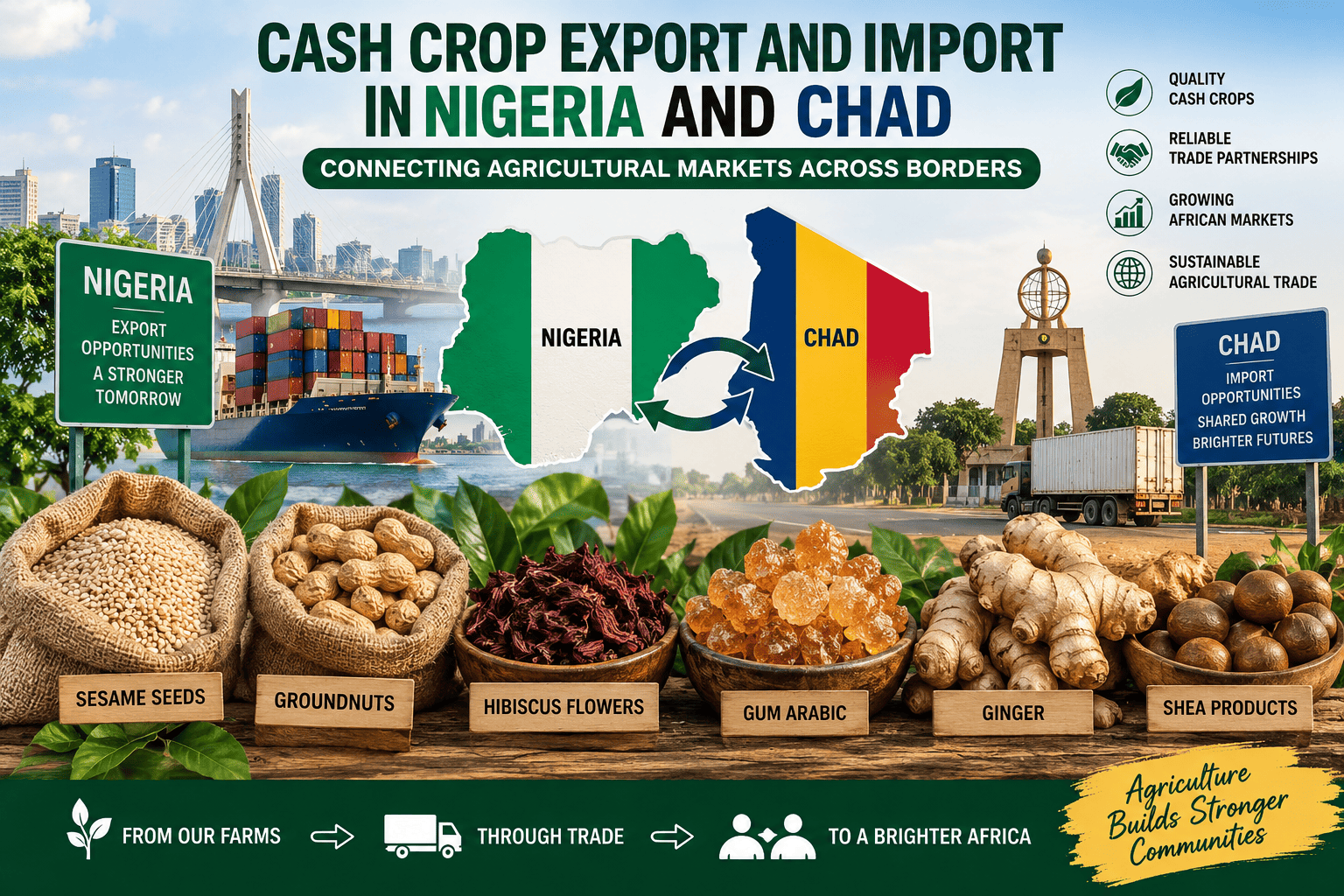
From sesame seeds and groundnuts to gum Arabic and hibiscus flowers, agricultural commodities produced within the region can serve domestic, regional, and international markets.
For businesses interested in agricultural trade, developing reliable sourcing networks and strong relationships between buyers and suppliers is essential.
Understanding Cash Crop Export and Import
Cash crops are agricultural products cultivated primarily for commercial purposes. Unlike crops produced mainly for household consumption, cash crops are grown and traded to generate income for farmers, suppliers, processors, and other businesses within the agricultural value chain.
Cash crop export involves supplying agricultural commodities from one country to buyers in another country, while importation involves bringing agricultural products into a country to meet local demand, processing requirements, or commercial needs.
In the context of Nigeria and Chad, agricultural trade can involve farmers, aggregators, commodity merchants, logistics providers, processors, wholesalers, exporters, importers, and end buyers.
A well-organised supply chain helps move agricultural products efficiently from their source to the market.
Cash Crop Export in Nigeria
Nigeria has a large agricultural sector with different crops produced across various parts of the country.
Beyond domestic consumption, several Nigerian agricultural commodities have commercial potential in regional and international markets.
Businesses involved in cash crop export in Nigeria may source products directly from farmers, farming communities, cooperatives, aggregators, commodity markets, or established suppliers.
Depending on the commodity and destination market, products may also require cleaning, sorting, grading, packaging, storage, transportation, documentation, and quality inspection before they are ready for export.
Building a reliable sourcing network is therefore an important part of successful agricultural export operations.
Cash Crop Trade in Chad
Agriculture and livestock activities are important parts of Chad’s economy, creating opportunities for domestic and cross-border agricultural commerce.
Its geographical position in Central Africa and proximity to Nigeria through the wider Lake Chad region also makes regional agricultural trade an important business consideration.
Agricultural products can move between suppliers and buyers based on production levels, seasonal availability, market demand, processing requirements, pricing, and applicable trade regulations.
Businesses exploring agricultural import and export opportunities in Chad should therefore understand both the products available and the requirements for moving commodities across borders.
Major Cash Crops and Agricultural Commodities
There are several agricultural commodities that businesses may consider when exploring trade opportunities between Nigeria, Chad, and other markets.
1. Sesame Seeds
Sesame is an important commercial agricultural commodity with applications in food production and processing.
Quality factors such as cleanliness, moisture content, purity, colour, packaging, and variety may influence buyer requirements.
Suppliers looking to participate in the sesame trade should pay close attention to product handling and the specifications requested by individual buyers.
2. Groundnuts
Groundnuts are widely consumed and can also serve as raw materials for different processed products.
They can be traded as raw groundnuts or processed into products such as groundnut oil and other food ingredients.
For commercial transactions, proper drying, storage, handling, and quality control are particularly important.
3. Gum Arabic
Gum Arabic is a natural product obtained from certain Acacia species and is used in several industries.
Depending on its grade and processing, it can have applications in food, beverages, pharmaceuticals, cosmetics, and other manufacturing activities.
Reliable sourcing and appropriate grading can be important when supplying commercial buyers.
4. Hibiscus Flowers
Dried hibiscus flowers are another agricultural commodity with commercial potential.
They are commonly used in beverages, herbal products, food products, and other applications.
Buyers may have specific requirements concerning colour, moisture, cleanliness, foreign matter, packaging, and general product quality.
5. Ginger
Ginger is an important agricultural commodity used in food preparation, beverages, spices, and other processed products.
Commercial buyers may purchase ginger in fresh, dried, powdered, or processed forms depending on their requirements.
6. Shea Products
Shea nuts and processed shea products can serve businesses operating in cosmetics, skincare, food processing, and related industries.
Quality, processing methods, packaging, and product specifications can vary significantly depending on the intended market.
Nigeria–Chad Cross-Border Agricultural Trade
Cross-border trade can connect areas where particular agricultural commodities are available with markets where demand exists.
For Nigeria and Chad, this creates opportunities for businesses to establish relationships across the agricultural supply chain.
A Nigerian buyer, for example, may identify an agricultural commodity available through suppliers in Chad. Likewise, businesses in Chad may source suitable products from Nigerian suppliers.
The opportunity is not limited to moving products in one direction.
A strong Nigeria–Chad agricultural trade network can support two-way commercial relationships based on demand, availability, price, quality, regulations, and logistics.
Connecting Agricultural Buyers and Suppliers
One of the biggest challenges in agricultural commodity trading is connecting serious buyers with dependable suppliers.
Buyers need confidence that suppliers can provide the agreed product, quantity, quality, documentation, packaging, and delivery arrangements.
Suppliers also need confidence that they are dealing with legitimate buyers capable of completing transactions according to agreed commercial terms.
This makes relationship building and proper verification essential.
A professional agricultural trade operation should focus on:
- Reliable agricultural sourcing
- Clear product specifications
- Quality control
- Transparent communication
- Appropriate packaging
- Proper documentation
- Efficient logistics coordination
- Reliable buyer and supplier relationships
These elements can reduce misunderstandings and help create long-term commercial partnerships.
Quality Control in Cash Crop Export
Quality is particularly important when dealing with agricultural commodities.
Different buyers and destination markets may have different standards. Therefore, exporters and suppliers should not assume that one quality specification applies to every transaction.
Before completing an order, important details should be clearly established, including product variety, grade, moisture level, purity, quantity, packaging, inspection requirements, and delivery terms where applicable.
Proper storage is equally important.
Agricultural products can deteriorate when exposed to inappropriate moisture, pests, contamination, heat, or poor storage conditions.
Maintaining product quality from sourcing through delivery helps protect both the supplier and buyer.
Packaging and Storage of Agricultural Commodities
Packaging serves several purposes in agricultural trade.
It protects commodities during handling and transportation, helps maintain quality, simplifies loading and unloading, and provides important product information where required.
The appropriate packaging will depend on the commodity and buyer requirements.
Before shipment, businesses should confirm specifications such as:
- Packaging material
- Weight per bag or package
- Labelling requirements
- Product grade
- Quantity
- Storage requirements
- Destination requirements
Proper warehousing should also be considered, especially when commodities will remain in storage before transportation.
Logistics for Nigeria and Chad Agricultural Trade
Moving agricultural commodities between countries requires careful logistics planning.
Transportation arrangements may involve collection from farms or warehouses, consolidation, loading, border procedures, customs processes, onward transportation, and final delivery.
Factors such as distance, road conditions, border requirements, shipment size, commodity type, security considerations, and transportation costs can affect the overall logistics plan.
Businesses should work with experienced logistics and customs professionals where appropriate and confirm current requirements before moving goods across international borders.
Documentation and Regulatory Compliance
Agricultural export and import transactions may require documentation from different government authorities depending on the commodity, origin, destination, shipment method, and applicable regulations.
Requirements can change, so businesses should verify the current rules with the appropriate authorities before completing a transaction.
Depending on the shipment, documentation may relate to areas such as:
- Business and exporter registration
- Customs declarations
- Commercial invoices
- Packing lists
- Certificates of origin
- Phytosanitary requirements
- Quality inspection
- Transportation documents
- Import or export permits where applicable
Compliance should be treated as an essential part of the transaction rather than an afterthought.
Benefits of Cash Crop Export and Import
Well-organised agricultural trade can provide benefits across different parts of the value chain.
Farmers may gain access to additional markets for their products. Suppliers can expand their customer networks. Processors can obtain raw materials required for production. Traders can connect supply with demand, while buyers can diversify their sourcing options.
Cross-border agricultural commerce can also encourage stronger commercial relationships between neighbouring markets.
For businesses, the opportunity is ultimately about finding the right combination of product availability, quality, demand, pricing, logistics, compliance, and reliable partnerships.
Challenges in Agricultural Commodity Trading
Despite its opportunities, agricultural trading involves risks and challenges that businesses need to manage carefully.
Commodity prices can change. Harvest seasons can affect availability. Poor storage can reduce product quality. Transportation delays may affect delivery schedules, while regulatory requirements can change.
There is also the risk of dealing with unreliable intermediaries or fraudulent buyers and suppliers.
Businesses should therefore conduct appropriate due diligence before entering significant transactions.
Product samples, inspections, contracts, agreed specifications, verified documentation, secure payment arrangements, and clear responsibilities can help reduce commercial risks.
Building Long-Term Agricultural Trade Partnerships
Sustainable agricultural trade depends on more than completing a single transaction.
Buyers often prefer suppliers who consistently provide products according to agreed specifications. Similarly, suppliers value buyers who communicate clearly and honour commercial agreements.
Building long-term relationships requires professionalism, transparency, consistency, and effective communication.
When both parties understand their responsibilities, agricultural trading can develop from occasional transactions into dependable commercial partnerships.
Expanding African Agricultural Trade
Africa has substantial agricultural resources, but connecting production to the right markets remains an important part of unlocking their commercial value.
Regional trade between neighbouring countries can help strengthen supply chains and create additional market opportunities.
Nigeria and Chad represent an example of how African businesses can explore cross-border agricultural commerce by connecting farmers, suppliers, traders, processors, logistics companies, and buyers.
With proper sourcing, quality management, documentation, logistics, and market development, cash crops can move more efficiently from areas of production to areas of demand.
Why Work With a Reliable Agricultural Trade Partner?
When sourcing or supplying agricultural commodities, reliability matters.
A dependable trade partner can help coordinate communication between buyers and suppliers, understand product requirements, organise sourcing, facilitate quality checks, and support logistics arrangements.
Whether you are searching for cash crop suppliers in Nigeria, exploring agricultural commodities in Chad, or looking for cross-border sourcing opportunities, working with credible partners can make the process more organised and transparent.
Conclusion
The export and import of cash crops in Nigeria and Chad present opportunities for farmers, suppliers, commodity traders, processors, wholesalers, exporters, importers, and investors involved in Africa’s agricultural value chain.
Products such as sesame seeds, groundnuts, gum Arabic, hibiscus flowers, ginger, and shea products can create commercial opportunities when supported by reliable sourcing, appropriate quality standards, proper documentation, efficient logistics, and strong buyer-supplier relationships.
Successful agricultural trade is not simply about finding products. It is about connecting the right products with the right markets through reliable and sustainable commercial partnerships.
If you are looking to buy, supply, export, or import cash crops and agricultural commodities between Nigeria and Chad, contact us to discuss your product requirements, quantity, destination, and potential business partnership.
Let’s connect African agricultural products with the markets that need them.